A Heavy Load
Age Range: 6-14 years
This worry visualization worksheet features a large outline of a pickup truck with an empty cargo bed, accompanied by the instruction: "This truck is carrying something you're worried about”. The truck metaphor transforms abstract anxiety into tangible cargo that can be visualized, measured, and potentially unloaded.
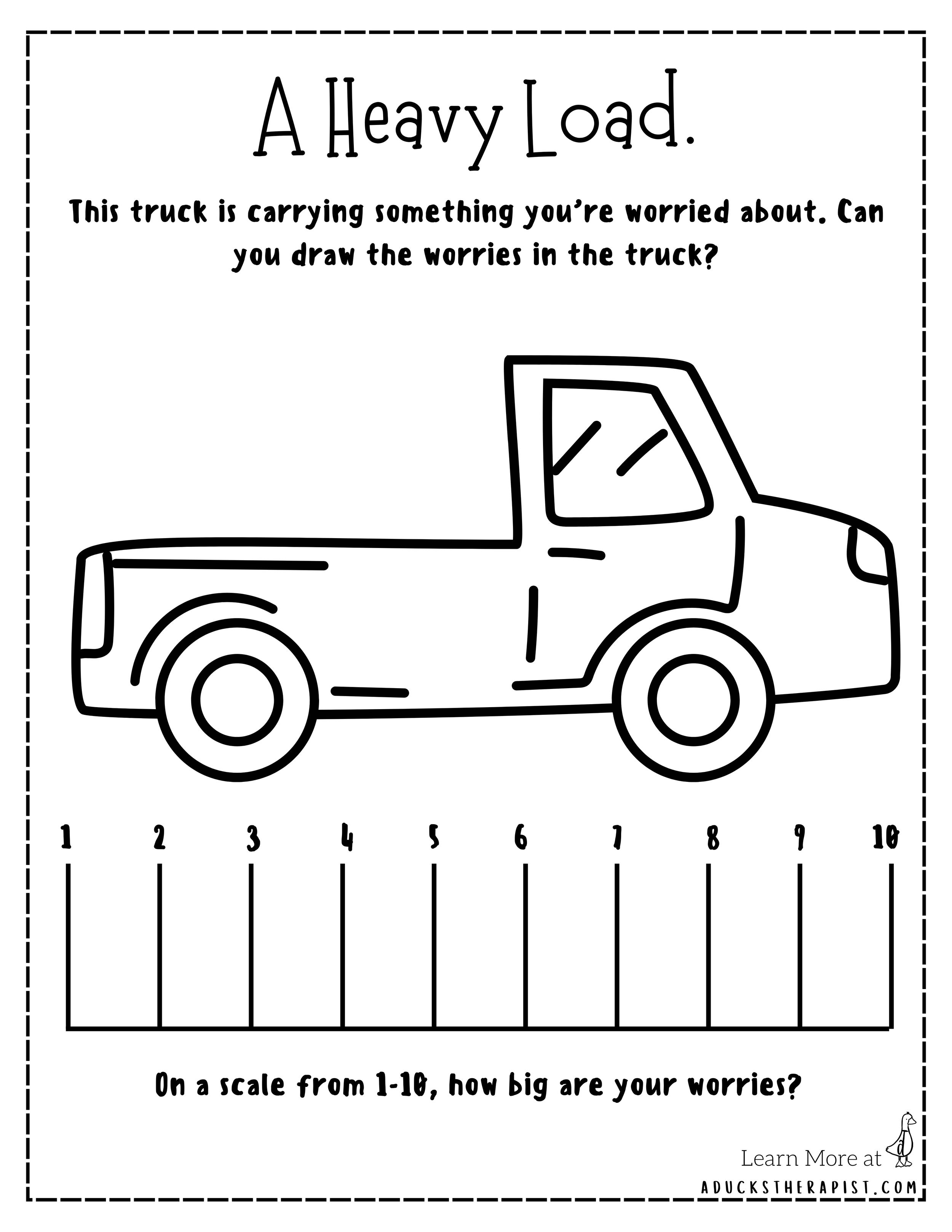
The "heavy load" metaphor is profoundly therapeutic. Anxiety often feels like carrying constant weight—exhausting, burdensome, limiting. By making this implicit metaphor explicit through the truck image, we validate the real physical experience of worry while also creating distance: the worries are cargo you carry, not who you are. This distinction is fundamental for cognitive defusion and anxiety management.
Therapeutic Objectives:
Externalize worries through creative visualization
Build awareness of worry as separate, "carryable" burden (not identity)
Practice quantifying anxiety through scaling
Identify specific worry content through drawing
Develop metacognitive awareness of worry size/weight
Create visual representation of emotional load
Build foundation for "unloading" worries through intervention
Processing Questions:
What did you draw in the truck? What are you carrying?
Looking at your drawing—how heavy does that look? How much weight?
On your scale, you marked [number]. What makes it that big?
If you could unload some of the truck, what would you unload first?
How long have you been carrying these worries in your truck?
Who knows you're carrying this heavy load?
What would it take to make the number smaller?
If you didn't have to carry these worries, what would change?
Therapy Theories:
Narrative Therapy: Externalizing problems (worry as separate entity)
Acceptance and Commitment Therapy (ACT): Defusion from thoughts, carrying vs. being defined by worries
Cognitive Behavioral Therapy (CBT): Worry identification, scaling techniques
Metaphor Therapy: Using concrete images for abstract experiences
Solution-Focused Therapy: Scaling questions, identifying change points
Gestalt Therapy: Making abstract concrete, embodiment of experience
Clinical Implementation:
For young children:
May need "worry" defined: "Things you think about that make you feel scared or nervous"
Drawings will be concrete: monsters under bed, getting lost, parent leaving, dog dying
May draw multiple small items or one large worry filling whole truck
Scale may be difficult: "Is your worry little like 1-2, medium like 5, or really big like 10?"
Simplify scale: "Little worry, medium worry, or BIG worry?"
Validate: "That does look like a heavy load for a kid to carry"
For adolescents:
Can articulate worries more specifically: "tests," "fitting in," "parents' health," "being embarrassed"
Drawings more detailed: might show scenes, events, or symbolic representations
Understand scale better: can differentiate between 6 and 8
May draw truck overflowing: "too much to fit"
Can process: "What makes your worry a 7 instead of a 4?"
Beginning to see: "My number changes—sometimes higher, sometimes lower"
Accompanying Activities:
Worry Unloading: For each worry in truck, identify: Can I control this? If yes, make plan. If no, practice letting go.
Empty Truck Visualization: Guided imagery of unloading truck, feeling lightness, freedom to move
Worry Container Transfer: Take worries from truck, put in container
Support System: "Who can help you carry this load? Who could drive the truck with you?"
Scale Analysis (1-10):
Very Low (1-3):
Minimal worry reported
May Indicate: Genuinely low anxiety, avoidance/minimization, or emotional suppression
Assess: Does drawing match number? If truck is full but scale is 2, explore discrepancy
Low-Medium (4-5):
Moderate, manageable worry level
Generally Healthy: Some worry is normal, adaptive
Indicates: Child has coping skills, worry doesn't dominate life
Medium-High (6-7):
Significant worry, starting to interfere
Clinical Range: Often when children seek treatment
Indicates: Worry is burdensome but child still functioning
High (8-9):
Severe worry, significant impairment
Concerning: Daily functioning affected
Common In: Anxiety disorders, requires intervention
Maximum (10):
Worst possible worry, emergency level
Red Flag: Crisis state, may indicate acute anxiety, panic, or crisis
Assess: Safety, immediate coping needs, intensity