Spotlight: Building a Feelings Vocabulary
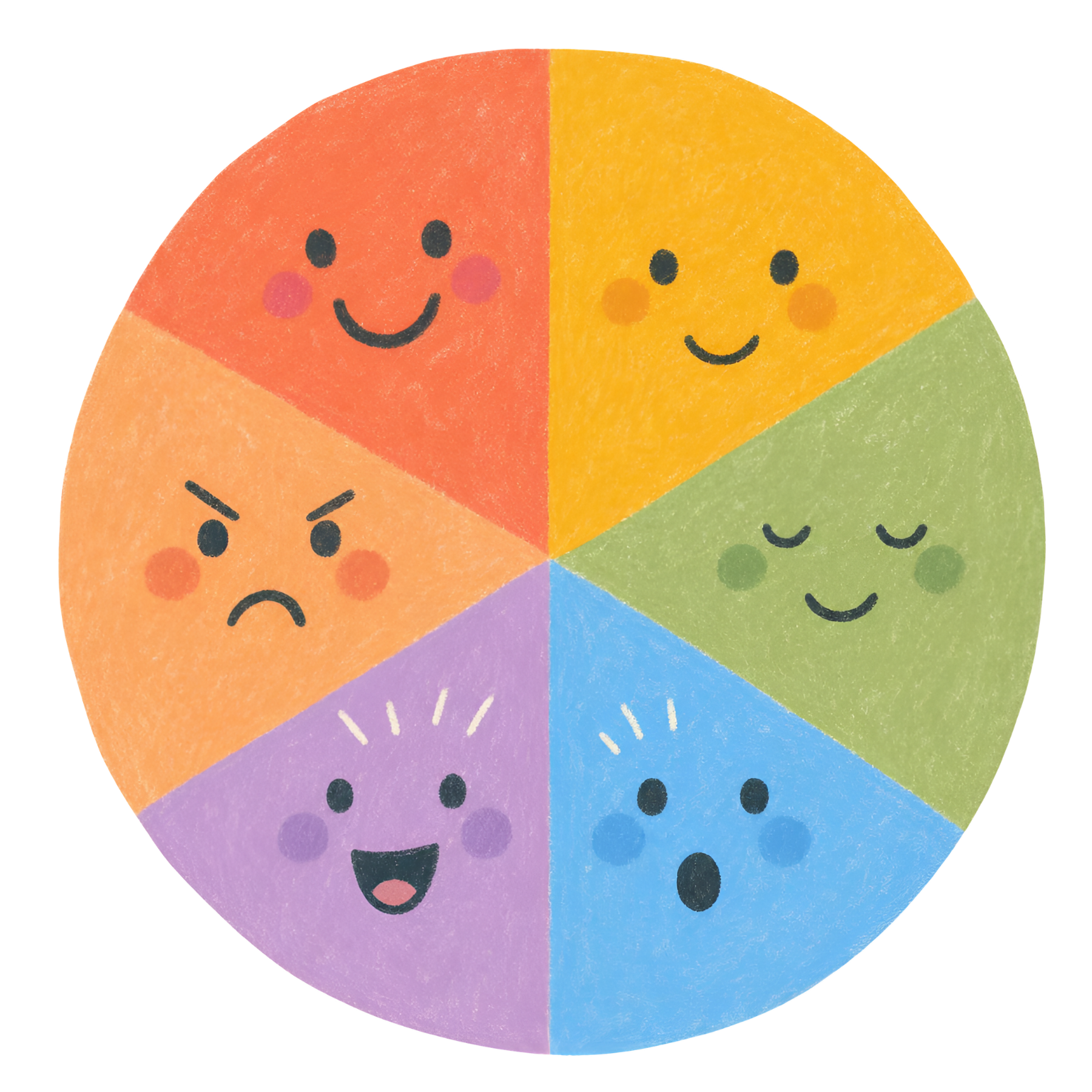
Kids can't manage a feeling they can't name. This Spotlight gives you a simple, research-backed way to grow a child's feelings words, starting in your very next session.
What It Is
A feelings vocabulary is the set of words a child has for what's happening inside them. Most kids arrive with three or four: happy, sad, mad, and sometimes scared. Everything else gets filed under one of those, or under "fine."
The goal isn't just a longer word list. It's emotional granularity: telling apart feelings that sit close together, like frustrated vs. disappointed or nervous vs. excited. A child who can say "I'm embarrassed" instead of "I'm mad" gets a different kind of help, from you and from themselves.
Why It Works
Naming a feeling calms it. In brain-imaging studies, putting a feeling into words ("affect labeling") lowered activity in the amygdala, the brain's alarm center (Lieberman et al., 2007).
Feelings knowledge predicts how kids do later. Children who could read and name emotions at age 5 showed better social behavior and school skills at age 9 (Izard et al., 2001).
Finer words mean better coping. People who tell their negative feelings apart more precisely are less likely to cope in unhelpful ways under stress, such as lashing out or shutting down (Kashdan, Barrett & McKnight, 2015).
Vocabulary drives the change. Kids' understanding of feelings grows more detailed across childhood, and their growing word knowledge helps explain why (Nook et al., 2017).
It's the foundation for everything else. CBT, emotion coaching, and school programs like RULER all start with recognizing and labeling feelings. A child has to name a worry before they can challenge it.
Three Things to Try This Week
1. Narrate out loud ("sportscasting").
When you see a feeling in session, name it gently as a guess: "Your shoulders went up when we talked about recess. I wonder if that felt a little nervous." Guessing lets the child correct you, which is its own practice.
2. Add one word a week.
Pick one "bigger" word that sits next to a word they already use: annoyed next to mad, disappointed next to sad, nervous next to scared. Teach it with a face, a body cue, and a real example from their week. Use it again every session.
3. Check in with a scale, not a yes/no.
Swap "Are you okay?" for "How big is it, 1 to 5?" or a color. Rating how strong a feeling is builds granularity just as much as learning new words.

Sample Script
A child tells you about losing a game at recess and says they felt "mad."
You: Mad makes a lot of sense. I'm wondering if there were any other feelings hiding in there too. Can I show you some feelings words?
(Lay out the These Are My Emotions page.)
You: Take a look. Do any of these fit, even a little bit?
Child: Maybe… embarrassed. Everyone saw.
You: Embarrassed. That's a really good word for it. Where did you feel embarrassed in your body?
Child: My face got hot.
You: Hot face. That's a clue a lot of people get with embarrassed. So it was mad and embarrassed. Both can be there at the same time. Next time your face gets hot, what could you tell yourself?
What you just did: You validated the first word, offered more words without correcting, linked the feeling to a body cue, named the mixed feelings, and pointed toward coping.
Adapting It by Age
Little Ducks (4–7)
Words to aim for: Happy, sad, mad, scared, surprised, silly, loved, then one new word at a time.
How to teach: Faces, colors, pictures, puppets, acting it out.
Best move: Name it for them, then let them point or copy the face.
Mixed feelings: Show two feelings in one picture (the We Can Feel Both butterfly).
Watch for: Kids who say "happy" to everything to please you.
Big Ducks (8–12)
Words to aim for: Frustrated, disappointed, embarrassed, jealous, anxious, lonely, proud, guilty.
How to teach: Word lists, feelings wheels, "how big" scales, their own examples.
Best move: Ask them to find the word, then compare two close words.
Mixed feelings: Talk about feelings "on top" vs. "underneath."
Watch for: "Fine" or "I don't know" as a shield. Offer choices instead of open questions.

Common Mistakes
Correcting the child's word. "You're not mad, you're sad" teaches them their read on themselves is wrong. Add words; don't replace theirs.
Teaching too many words at once. A 20-word poster in session one is a wall. One or two new words a week sticks better.
Only naming the hard feelings. Name calm, proud, and excited too, or feelings talk starts to mean "you're in trouble."
Skipping the body. Words stick when they're tied to a body cue (hot face, tight tummy). The body is often where kids notice a feeling first.
Keeping it in the office. Share the "word of the week" with the parent so it gets used at home.
Use It With This Month's Pages
These Are My Emotions (Sets A & B): Word bank for the script above; 18 feelings to draw and point to.
I Spy Emotions!: Little Ducks finding feelings on faces and bodies.
What Makes You Feel…: Linking each feeling to real situations.
Magic Mirror: Outside face vs. inside feeling.
Feelings Pictionary: Drawing feelings so a partner can guess.
Check-ins (Color Crayon, Emotion Pie, Stick Figure, One Word): Practicing feeling words and rating how big a feeling is.
Sources
Izard, C., Fine, S., Schultz, D., Mostow, A., Ackerman, B., & Youngstrom, E. (2001). Emotion knowledge as a predictor of social behavior and academic competence in children at risk. Psychological Science, 12(1), 18–23.
Kashdan, T. B., Barrett, L. F., & McKnight, P. E. (2015). Unpacking emotion differentiation. Current Directions in Psychological Science, 24(1), 10–16.
Lieberman, M. D., et al. (2007). Putting feelings into words: Affect labeling disrupts amygdala activity in response to affective stimuli. Psychological Science, 18(5), 421–428.
Nook, E. C., Sasse, S. F., Lambert, H. K., McLaughlin, K. A., & Somerville, L. H. (2017). Increasing verbal knowledge mediates development of multidimensional emotion representations. Nature Human Behaviour, 1, 881–889.
Brackett, M. (2019). Permission to Feel. Celadon Books.