
Hop Away Your Anger
Click to download PDF
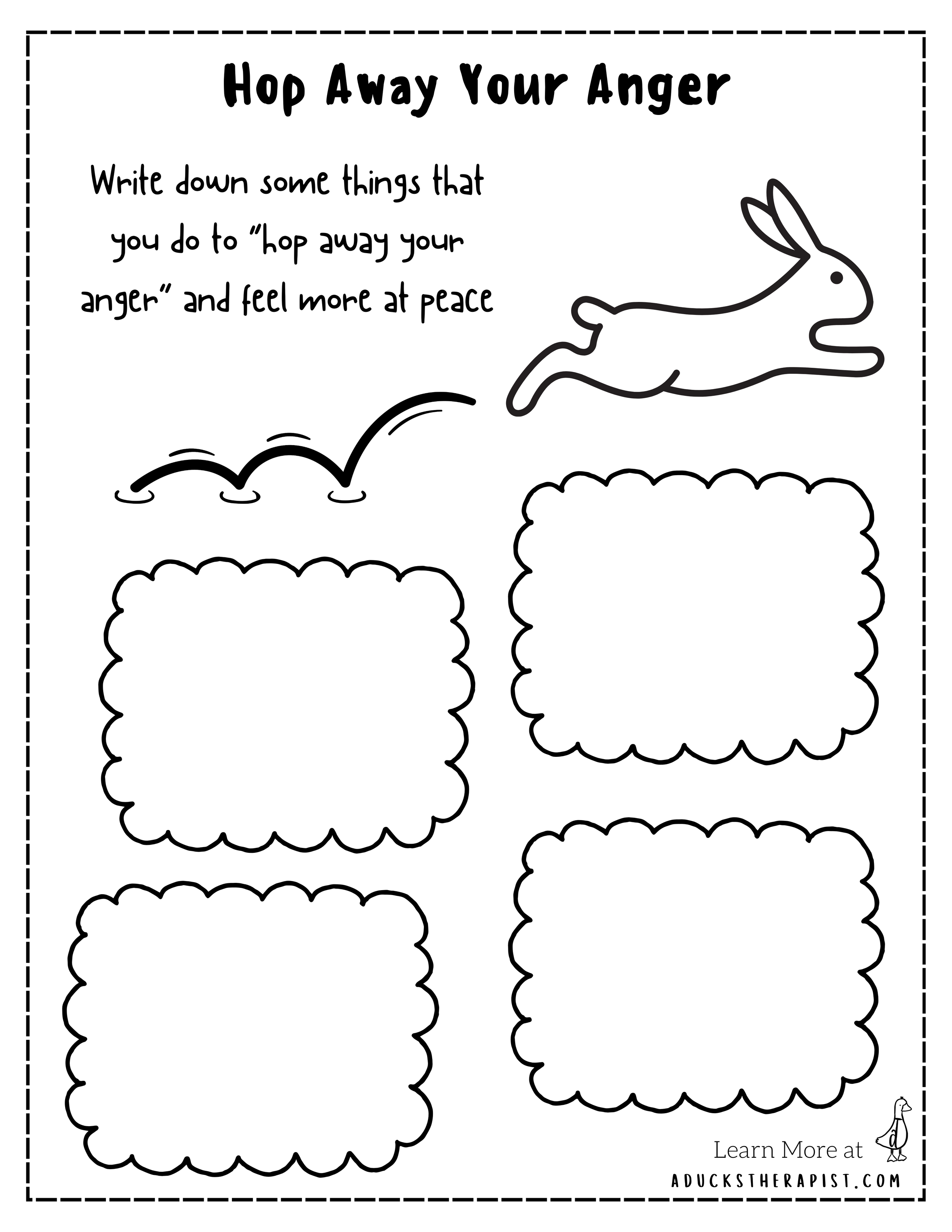
Hop Away Your Anger is a worksheet designed to help children identify and articulate their personal anger coping strategies. This activity invites children to externalize anger as something they can move through rather than something that traps them.
This worksheet is appropriate for individual therapy, small group sessions, and psychoeducation with parents. It works beautifully as a take-home tool for building a personalized coping skills "menu."
A Little About Anger in Kids
Anger is one of the most misunderstood emotions in childhood — and one of the most important ones to validate. For kids, anger often shows up as a secondary emotion, sitting on top of something deeper like fear, embarrassment, disappointment, or feeling unheard. Neurologically, when a child is angry, their downstairs brain (the limbic system and brainstem) is in the driver's seat, and their upstairs brain — the part responsible for logic, empathy, and problem-solving — goes temporarily offline.
This means kids don't need to be reasoned out of anger; they need support moving through it first. That's where coping skills come in. When children have a practiced toolkit of strategies, they build the neural pathways that make regulation faster and more accessible over time. The goal isn't to eliminate anger — it's to help kids develop a healthy relationship with it.
Coping Skills for Anger in Kids
Here are some evidence-informed strategies children can write into their clouds:
Body-Based (Somatic)
Jumping, running, or hopping in place
Doing 10 jumping jacks
Squeezing a stress ball or pillow
Taking a cold drink of water
Shaking their hands out like they're drying them
Bear hugging themselves tightly, then releasing
Breath-Based
Balloon breathing (big belly breath in, slow breath out)
Smell the flowers, blow out the candles
4-7-8 breathing
Dragon breathing (forceful exhale through the mouth)
Cognitive / Expressive
Drawing or scribbling how the anger feels
Writing a letter they don't send
Saying "I feel angry because ___"
Counting to 10 slowly
Environmental / Sensory
Going outside for fresh air
Listening to a favorite song
Asking for a hug or alone time (based on their preference)
Going to a calm-down corner or safe space
Connection-Based
Telling a trusted adult
Using a feeling word instead of acting out
Asking for help
Guiding Questions for Session
Opening / Warm-Up
"Have you ever felt really angry about something? What did that feel like in your body?"
"What does anger look like for you — does it feel like a fire, a storm, something else?"
Exploring Coping
"When you're angry, what's one thing that sometimes helps you feel a little better?"
"Is there something you do to calm down that you might not even think of as a 'calm-down trick'?"
"Have you ever tried moving your body when you're angry — like jumping or running? What happened?"
Connecting to the Worksheet
"The bunny is hopping away from something heavy and landing somewhere lighter. What would you want to hop away from, and where would you want to land?"
"If you filled in all five clouds, what would be on your list?"
Deepening (for older or more verbal kids)
"Are there some strategies that work better at school versus at home?"
"Is there anything that people tell you to do when you're angry that actually makes it worse?"
"What's one strategy you haven't tried yet but might want to?"
Closing / Integration
"Which of these do you want to try the next time you feel your anger starting to build?"
"Who in your life could remind you of this list when you're having a hard moment?"
Additional Therapeutic Thoughts
Use it before the anger hits. This worksheet is most powerful when completed during a regulated state, not in the middle of a meltdown. Helping kids build their list before they need it creates a resource they can actually access when the window of tolerance narrows.
Involve caregivers. Consider sending a completed copy home and inviting a parent or caregiver to read through it together. When adults know a child's preferred strategies, they can offer them as co-regulation prompts rather than demands ("Hey, do you want to try that jumping thing you told me about?").
Revisit and revise. Coping strategies evolve as kids grow. This worksheet can be revisited across sessions to add new skills, retire ones that no longer fit, and celebrate growth.
Watch for avoidance vs. regulation. Not all "calm-down" strategies are equal — some kids will name things like screen time or sleeping that may be avoidance rather than true regulation. This is a gentle clinical moment to explore the function of the strategy alongside the child without shame.
Normalize the mess. Let kids know that coping skills don't always work perfectly, and that's okay. Even a strategy that helps 20% is worth having in the toolkit.