Nervous Thoughts
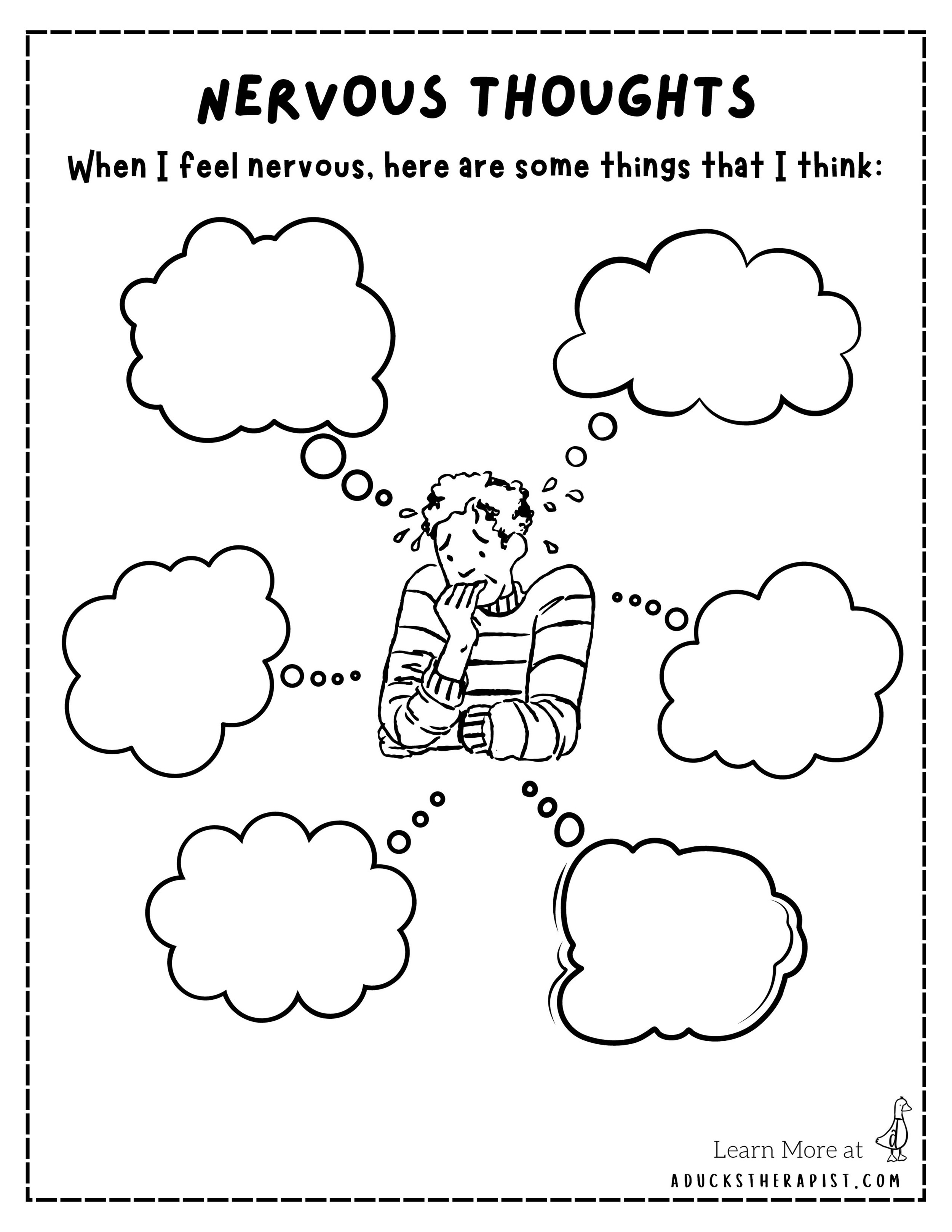
Age Range: 7-12 years
Description: This thought identification worksheet is foundational CBT work that makes automatic thoughts conscious and explicit. Anxious thoughts run like background soundtrack, barely noticed but profoundly influential. This worksheet brings them into awareness: "What exactly does your anxiety say?" Once identified, thoughts can be examined, challenged, restructured.
The instruction "When I feel nervous, here are some things that I think" links feeling (nervous) to thoughts (what I think). This builds awareness of thought-feeling connection: "When I feel nervous, my brain generates specific types of thoughts." It's not random—anxiety produces predictable thought patterns.
Therapeutic Objectives:
Identify and articulate automatic anxious thoughts
Build metacognitive awareness (awareness of own thinking)
Externalize anxious thoughts (thoughts as observable objects, not truth)
Create inventory of cognitive distortions for restructuring work
Practice labeling and naming worry thoughts
Reduce fusion with thoughts (I have anxious thoughts vs. I am anxious)
Normalize that anxious thoughts are common and universal
Generate content for cognitive restructuring interventions
Distinguish between thoughts and facts
Build foundation for thought challenging and defusion work
Processing Questions:
What nervous thoughts did you write in your bubbles?
Which thought is the loudest or most frequent?
Which thought bothers you the most?
Do these thoughts feel true when you have them?
Are these thoughts ever NOT true? When?
Where do you think these thoughts come from?
Do you believe everything these thoughts tell you?
How do these thoughts make you feel?
What do you do when you have these thoughts?
If a friend had these exact thoughts, what would you tell them?
Are these thoughts helpful or unhelpful?
Can you have these thoughts and still do what you want to do?
Common Nervous Thoughts by Category:
Social Anxiety Thoughts:
"They'll think I'm weird/stupid/boring"
"Everyone will laugh at me"
"I'll embarrass myself"
"They'll see I'm nervous"
"No one will like me"
"I'll say something dumb"
"They're judging me"
Performance Anxiety Thoughts:
"I'll fail"
"I'm going to mess up"
"I'll forget everything"
"I'll disappoint everyone"
"I won't be good enough"
"I have to be perfect"
"Everyone will see me fail"
Safety/Danger Thoughts:
"Something bad will happen"
"I'm in danger"
"I'll get hurt"
"Someone will hurt me/my family"
"There will be an emergency"
"I'm not safe"
Health Anxiety Thoughts:
"I'm sick"
"Something's wrong with me"
"I'm dying"
"This pain means something serious"
"I'll get sick"
"I can't breathe"
Separation Anxiety Thoughts:
"What if Mom doesn't come back"
"Something will happen to her"
"I'll be alone forever"
"They'll forget about me"
"They'll abandon me"
Generalized Anxiety Thoughts:
"What if...?" (generic, multiple scenarios)
"Something will go wrong"
"I can't handle it"
"Everything is going to fall apart"
"I'm not prepared"
Self-Focused Negative Thoughts:
"I'm stupid"
"I'm a failure"
"I'm not good enough"
"I'm worthless"
"Everyone is better than me"
"I can't do anything right"
Cognitive Distortions:
Catastrophizing:
"Everything will go wrong"
"It will be terrible"
"The worst will happen"
Mind Reading:
"They think I'm weird"
"Everyone is judging me"
"She's mad at me"
Fortune Telling:
"I'll fail"
"I won't be able to do it"
"Something bad will happen"
All-or-Nothing:
"I have to be perfect"
"If I make one mistake, I'm a failure"
"Everyone will hate me" (vs. some might not like me)
Personalization:
"It's my fault"
"I caused this"
"Everything bad is about me"
Should Statements:
"I should be better"
"I have to be perfect"
"I shouldn't feel this way"
Overgeneralization:
"This always happens"
"Nothing ever goes right"
"I never do well"