I Spy Emotions!
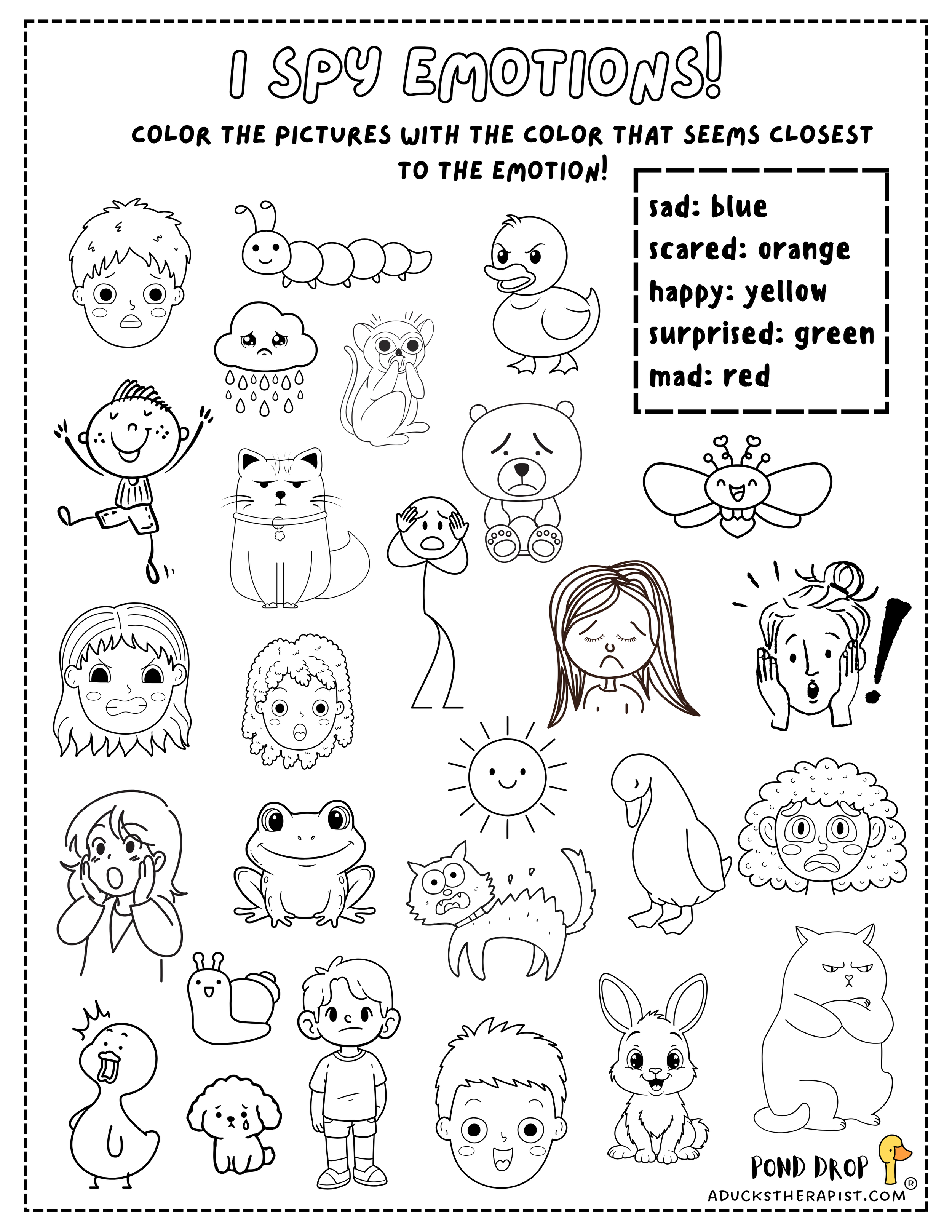
Ages: 4–7 · Time: 40–45 min · You'll need: blue, orange, yellow, green, and red crayons; a picture book or magazine (optional)
Session goal: The child learns to read feelings on other faces and bodies, the first step toward empathy and toward noticing their own feelings.
Why it helps
Reading faces comes first. Young children learn emotions by recognizing them in others before naming them in themselves. Emotion recognition at age 5 predicts better social skills years later.
Low pressure. Searching for feelings in animals and cartoons is safer than talking about your own. It's play first, therapy second.
Color coding adds a memory hook. Linking a feeling to a color gives pre-readers a way to sort feelings without words.
Body clues, not just faces. The pictures include posture (hands on head, crossed arms, jumping), which teaches kids that feelings show up in the whole body.
Session flow
Check in (5 min): Color Crayon Check-In. Compare their colors to the I Spy key: "You picked purple for sad, and this page uses blue. Both are okay!"
Warm up: Feelings Freeze Dance (5 min). Play music. When it stops, call out a feeling (happy, mad, scared) and the child freezes in that pose.
Worksheet (15 min). Hunt for one feeling at a time: "Let's find all the scared ones!" Color as you go. Talk about the clues: "How do you know the cat is scared?"
Bring it to life: I Spy in a Book (10 min). Flip through a picture book or magazine and play "I spy someone who feels…" Take turns being the spy.
Close (5 min): "Which feeling was easiest to find? Which feeling did you feel today?" Do 3 balloon breaths together.
Questions to ask
"What clues tell you how this one feels? Look at the eyes, mouth, and body."
"Why do you think the bear feels sad? What might have happened?"
"What could someone do to help the scared cat feel better?"
"Have you ever made a face like this one?"
"Which picture looks most like you today?"
Therapeutic thoughts
Disagreements are great. If a child thinks a "surprised" picture looks scared, that's a real and useful observation. Faces can be confusing, and that's okay.
Watch for faces they misread. Children who often read neutral or surprised faces as angry may be on alert for threat, which can happen after conflict or trauma at home. Note the pattern rather than drawing conclusions.
Notice their reactions. A child who rushes past the angry faces or gets very interested in the sad ones is telling you something.
The key isn't a rule. Some kids will want to use their own colors. Let them, and ask why.
Adapting it
Age 4: Hunt for just happy and sad. Point and name rather than coloring every one.
Ages 7–8: Add a challenge: find two pictures that might be feeling two things at once.
Groups: Turn it into a race. Who can find all the surprised ones first?
Take-home practice
Play "I spy a feeling" at dinner or in the car. Spot one feeling on someone's face (a TV character counts!).